Forex Trading for Beginners in 2026
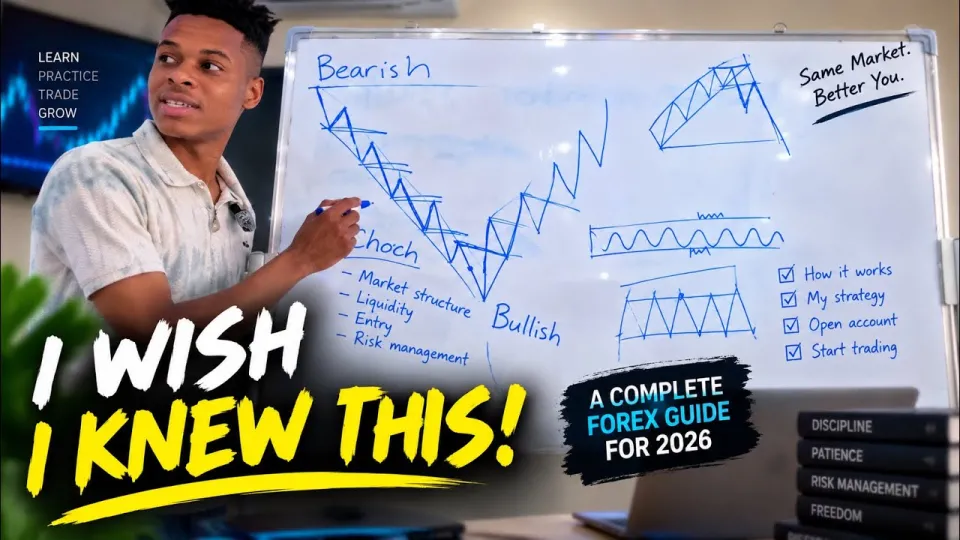
Video: How To Start Forex Trading For Beginners in 2026 (Full Guide + My Strategy)
Want articles like this for your own video to promote it on YouTube and Google? Order them through the Telegram bot @sat_sit_bot. It writes articles around your video, embeds the video and publishes them on popular niche websites (no ads). Free trial — 50 articles.
Key takeaways
- Forex is an over-the-counter market where currencies are traded in pairs, and retail traders usually access it through a broker rather than an exchange.
- A beginner's path is: learn the basics, open a demo account, then a live account with a broker such as TFC Global Markets, and only then trade small size.
- Market structure — higher highs and higher lows for bullish trends, lower highs and lower lows for bearish ones — is the core skill behind price action trading.
- Risk management, not prediction, keeps an account alive: fixed risk per trade and a stop loss on every position.
- Trading is a skill built over months of practice; no strategy guarantees profits, and leveraged forex trading can lose more than expected.
Forex trading is the buying and selling of currency pairs on the foreign exchange market, the largest and most liquid financial market in the world, where retail traders participate through a broker rather than a central exchange. For a beginner, the practical route is to learn how currency pairs and leverage work, practise on a demo account, then open a live account — the broker used in Carl Fx's walkthrough, TFC Global Markets, offers registration through this link. This guide covers the mechanics, the account-opening steps, market structure and a simple strategy framework you can practise before risking real money.
What forex trading actually is
Forex is a decentralised market where national currencies are quoted in pairs, and the price of a pair expresses how much of the quote currency is needed to buy one unit of the base currency. When you trade EUR/USD, for example, the euro is the base currency and the US dollar is the quote currency; buying the pair means you expect the euro to strengthen against the dollar.
Three details define the retail experience:
- It is over-the-counter. There is no single exchange; banks, funds and brokers form a network of liquidity providers, and your broker is your counterparty or routes your order into that network.
- It runs almost around the clock. Trading opens in Sydney on Sunday evening and closes in New York on Friday, which is why the most active hours are the London and New York sessions.
- Leverage is built in. A broker may let you control a position many times larger than your deposit, which magnifies both gains and losses — this is the single biggest reason beginners blow up accounts.
Prices are driven by interest rates, inflation data, central-bank decisions, employment reports and risk sentiment. A beginner does not need to forecast the economy; they need to understand that scheduled news can move a pair violently within minutes, and position size accordingly.
How to open a trading account from zero
Opening a forex account is a short administrative process, but the order in which you do things matters more than the paperwork. Carl Fx's walkthrough starts with the broker sign-up and moves into platform setup, and the same sequence works for almost anyone.
- Pick a regulated broker. Check where the entity is licensed, what leverage it offers to your country, and what the spreads and commissions look like on the pairs you intend to trade.
- Register and verify. You will need ID, proof of address and, depending on the jurisdiction, a short appropriateness questionnaire. Registration with TFC Global Markets is done through https://www.tfcglobalmarkets.com/sign-up?ref=CARLFX.
- Install a platform. MetaTrader 4 or MetaTrader 5 are the standard choices; both support charts, indicators and demo accounts.
- Fund the account. Start with an amount you can afford to lose entirely — the point of the first deposit is education, not income.
- Place a first trade on demo. Execute the exact strategy you intend to use live, on the same pairs and the same timeframe, for at least a few weeks.
A demo account is not a formality. It is where you discover whether your strategy has an edge and whether you can follow your own rules when a position goes against you.
Reading bullish and bearish markets through market structure
Market structure is the skeleton of price action: it describes whether price is making higher highs and higher lows, or lower highs and lower lows. A bullish market prints a sequence of rising swing highs and rising swing lows; a bearish market prints falling highs and falling lows. When that sequence breaks — a bullish structure fails to make a new high and then breaks its last higher low — the trend is shifting.
This matters because most simple strategies are trend-following or reversal strategies, and both depend on knowing which regime you are in. Two practical habits help:
- Mark the swings on a higher timeframe first. Identify the last clear high and low on the daily or four-hour chart, then drop to a lower timeframe for entries.
- Wait for confirmation. A break of structure is more reliable when price closes beyond the level rather than simply wicking through it.
Support and resistance zones, supply and demand areas and round numbers all work as reference points inside that structure. None of them are magic levels; they are places where you expect a reaction and plan your risk around it.
A simple strategy framework to practise
The strategy Carl Fx demonstrates follows a pattern most beginner-friendly systems share: identify the trend, wait for a pullback into a zone, and enter on confirmation with a defined stop. You can rebuild it in four steps.
- Bias. On the four-hour chart, decide whether structure is bullish or bearish. Trade only in that direction until structure changes.
- Zone. Mark the last area of consolidation or the origin of the impulse move that broke structure — that is your area of interest.
- Entry. Drop to a lower timeframe and wait for a reversal signal inside the zone, such as a break of a small counter-trend structure or an engulfing candle.
- Risk. Place the stop beyond the swing that invalidates the idea, and size the position so the loss is a fixed small percentage of the account — commonly 1% or less.
Record every trade: pair, session, reason for entry, result. After 30 to 50 trades the journal tells you more about your edge than any indicator will.
Common mistakes beginners make
Most beginner losses come from process failures rather than bad analysis. The recurring ones are worth naming explicitly.
- Overleveraging. Trading a large lot size on a small account means a normal losing streak wipes the balance.
- No stop loss. A position without a stop is not a trade, it is a hope; news spikes can move dozens of pips in seconds.
- Revenge trading. Doubling size after a loss to recover it quickly is the fastest route to a blown account.
- Strategy hopping. Switching systems after three losing trades prevents you from ever gathering enough data to judge one.
- Skipping the demo phase. Going live before you can execute your plan mechanically turns tuition fees into real losses.
Beginner questions answered
Many viewers of the guide ask practical questions before their first trade, and a few themes come up repeatedly. The first is capital: there is no universal minimum, but a deposit so small that a single stop loss removes a large share of it makes proper risk management impossible. The second is the demo-to-live transition — the usual advice is to stay on demo until you have a documented, repeatable process, then move to a live account with the smallest size the broker allows.
The third theme is account verification and funding, which is often the step where new traders get stuck; documents must match the name on the account, and funding methods vary by country. The fourth is impatience: expecting consistent income in the first months is unrealistic, and treating the first year as paid education is a healthier framing. Finally, chart examples matter — abstract rules become clear only when you mark structure and zones on real historical charts, so build a small library of annotated screenshots as you study.
Useful links
- Broker registration used in the walkthrough: TFC Global Markets sign-up
- Free community and additional material from the channel: https://t.me/carlsmcforex
The bottom line
Forex trading rewards a repeatable process — a defined market bias, a clear entry zone, a stop loss and a position size that keeps any single loss small — far more than it rewards prediction. The beginner's sequence is unglamorous: learn the mechanics, practise on demo, document every trade, and only scale up once the numbers justify it. Carl Fx's full guide is a useful starting point because it walks through the broker setup, market structure and a simple strategy in one pass, without promising overnight returns. Treat leverage as a tool for efficiency rather than a shortcut to profit, and expect the learning curve to be measured in months. If you are ready to open an account, you can start with registration at TFC Global Markets.
Source: How To Start Forex Trading For Beginners in 2026 (Full Guide + My Strategy) · Markdown version
Questions & answers
How much money do I need to start forex trading?
There is no fixed minimum, but the amount should be small enough that you can lose it without affecting your life, yet large enough that a 1% risk per trade is a meaningful position. Many brokers accept deposits of a few dozen dollars, though very small accounts make proper risk control difficult. Start on demo and size your first live deposit around what you are willing to spend on learning.
How long should I stay on a demo account before trading live?
Stay on demo until you can execute your strategy mechanically and have a documented record of at least a few dozen trades. If your results depend on breaking your own rules, more demo time is needed. The transition should be to a live account with the smallest position size available, not to full-size trading.
Is forex trading profitable for beginners?
Most beginners lose money in their first months, largely because of overleveraging, missing stop losses and switching strategies too often. Profitability comes from a tested edge plus consistent risk management, and even then returns are never guaranteed. Treat the first year as education rather than income.
What is market structure and why does it matter?
Market structure describes the sequence of swing highs and lows: rising highs and lows indicate a bullish trend, falling ones a bearish trend. It matters because it tells you which direction to trade and when the trend has likely changed. Most simple strategies, whether trend-following or reversal, depend on reading it correctly.